On this page
- What this calculator does
- The 9-1 GCSE grading scale
- Standard pass and strong pass
- How Attainment 8 works
- The four Attainment 8 buckets in detail
- A worked example
- Sixth Form and college entry thresholds
- Common mistakes when reading GCSE results
- Where this calculator stops
- Double award science: The 17-point 9-9 to 1-1 scale
- Foundation vs Higher tiering and grade boundary dynamics
- How schools convert Attainment 8 into Progress 8
- Subject-specific A-Level and T-Level entry matrix
- Compulsory post-16 retake rules and funding conditions
- Sources
What this calculator does
This tool takes your GCSE subjects and grades and produces three things: your average numerical grade across every subject entered, your Attainment 8 score calculated under the Department for Education rules, and a Sixth Form or college eligibility band based on the standard thresholds that most institutions apply. A second mode handles a single subject with multiple papers, and forecasts the mark needed on the remaining papers to reach a target grade.
The reason the tool is worth using rather than counting manually is that Attainment 8 is not a straight average. It is a bucket system with four categories, two of which are double-weighted, and the highest grades are selected into each bucket rather than simply counted. A candidate who enters English Language, English Literature, Mathematics, Combined Science, History, French, Computer Science, and Business Studies has to sort those subjects into the four buckets correctly before the points can be added up. The tool does that sorting automatically and shows the resulting score.
Every calculation runs inside your browser. No grade, no subject name, and no personal detail is uploaded. If you press the AI insight button, only an anonymous summary of the mode, the number of subjects entered, the average grade or weighted percentage, the Attainment 8 total, and the eligibility band is sent to a small serverless function that runs once and then stops.
The 9-1 GCSE grading scale
GCSEs in England moved from the legacy alphabetical grades to a numerical 9-1 scale from 2017 onwards. The new scale was introduced by Ofqual to create finer distinctions at the top end of the cohort, where the old A* grade covered too wide a range of performance to be useful for higher education admissions. Grade 9 is the highest award and is reserved for roughly the top twenty per cent of candidates who would have achieved A* under the old system. Grade 1 is the lowest graded pass, and U is ungraded.
| Grade | Legacy equivalent | Attainment 8 points |
|---|---|---|
| 9 | Above A* | 9.0 |
| 8 | High A* | 8.0 |
| 7 | Standard A | 7.0 |
| 6 | High B | 6.0 |
| 5 | Low B to high C (strong pass) | 5.0 |
| 4 | Low C (standard pass) | 4.0 |
| 3 | D | 3.0 |
| 2 | E to high F | 2.0 |
| 1 | F to G | 1.0 |
| U | Ungraded | 0.0 |
The numerical scale runs in a way that lets the highest grades carry extra information. Where the legacy system had one A* grade covering a wide range of performance, the new system uses Grade 9 and Grade 8 to split that group, so a very strong candidate is distinguished from a merely excellent one. At the bottom of the scale the difference is smaller, and Grade 4 and Grade 3 straddle the old Grade C boundary in a way that was designed to be roughly comparable to the pass rate under the old system.
Northern Ireland uses a hybrid system that retains the legacy letters for its own qualifications, and Wales uses a similar arrangement, so the 9-1 scale is not applied identically across all four nations. The international GCSE qualifications from Cambridge International and Pearson Edexcel are offered in both the 9-1 and A*-G variants, and the specific grading scheme depends on which variant the candidate sat.
Standard pass and strong pass
The Department for Education distinguishes between two key benchmarks on the 9-1 scale. The first is the standard pass at Grade 4, which is the minimum grade in English Language and Mathematics that lets a candidate progress to Level 3 study without compulsory resits. The second is the strong pass at Grade 5, which sits between the top third of the old Grade C and the bottom third of the old Grade B, and is the grade the DfE uses as the headline benchmark in school performance tables.
The distinction matters in practice because different institutions use different thresholds. A Sixth Form College that sets Grade 4 as its minimum is admitting a wider range of candidates than a grammar school that sets Grade 6 or Grade 7. The strong pass at Grade 5 is the middle ground, and it is the threshold that most schools and colleges quote when they publish their published entry requirements. A candidate reading the requirements carefully should check whether the specific subjects they want to study ask for a standard pass, a strong pass, or a higher grade in the specific subject.
Resits in English and Mathematics are statutory. A candidate who finishes Year 11 with a Grade 3 in either subject must continue studying it into post-16 education and resit the examination until they achieve a Grade 4. The condition applies in England and is a funding requirement for the post-16 provider. Candidates with Grade 2 or below may take Functional Skills Level 2 as an intermediate step before returning to the GCSE.
How Attainment 8 works
Attainment 8 is the headline academic measure the Department for Education uses to compare school performance. It is not a simple average, and it is not a count of every subject the candidate sat. Instead, it takes eight qualifying subjects and arranges them into four buckets, with the English and Mathematics buckets carrying double weight and the EBacc and Open buckets carrying single weight. The maximum possible Attainment 8 score is ninety points, which corresponds to Grade 9 in all eight counted positions.
Maximum possible = 90 points (all Grade 9)
The English bucket takes the higher of the candidate's English Language and English Literature grades and doubles it. The Mathematics bucket doubles the Mathematics grade. The EBacc bucket takes the three highest grades from the EBacc subject list, which covers the sciences, computer science, history, geography, and the modern and ancient languages. The Open bucket takes the three highest grades from everything else, including any EBacc subject that did not fit into the EBacc bucket and any second English grade if there is room.
The effect of the bucket system is that certain subjects carry more weight than others. A strong grade in English Literature contributes both to the English bucket, where it may be doubled, and to the Open bucket, where it fills one of the three slots. A strong grade in an EBacc subject such as History or French contributes first to the EBacc bucket and then, if the EBacc bucket is full, to the Open bucket. The Open bucket is therefore the flexible one, and a candidate with a broad subject list has more options for filling it with strong grades.
The four Attainment 8 buckets in detail
Each bucket has its own rules, and understanding them makes it clear which subjects matter most for the final score. A candidate who plans their subjects in advance can often improve their projected Attainment 8 by choosing subjects that fit the buckets they need to fill.
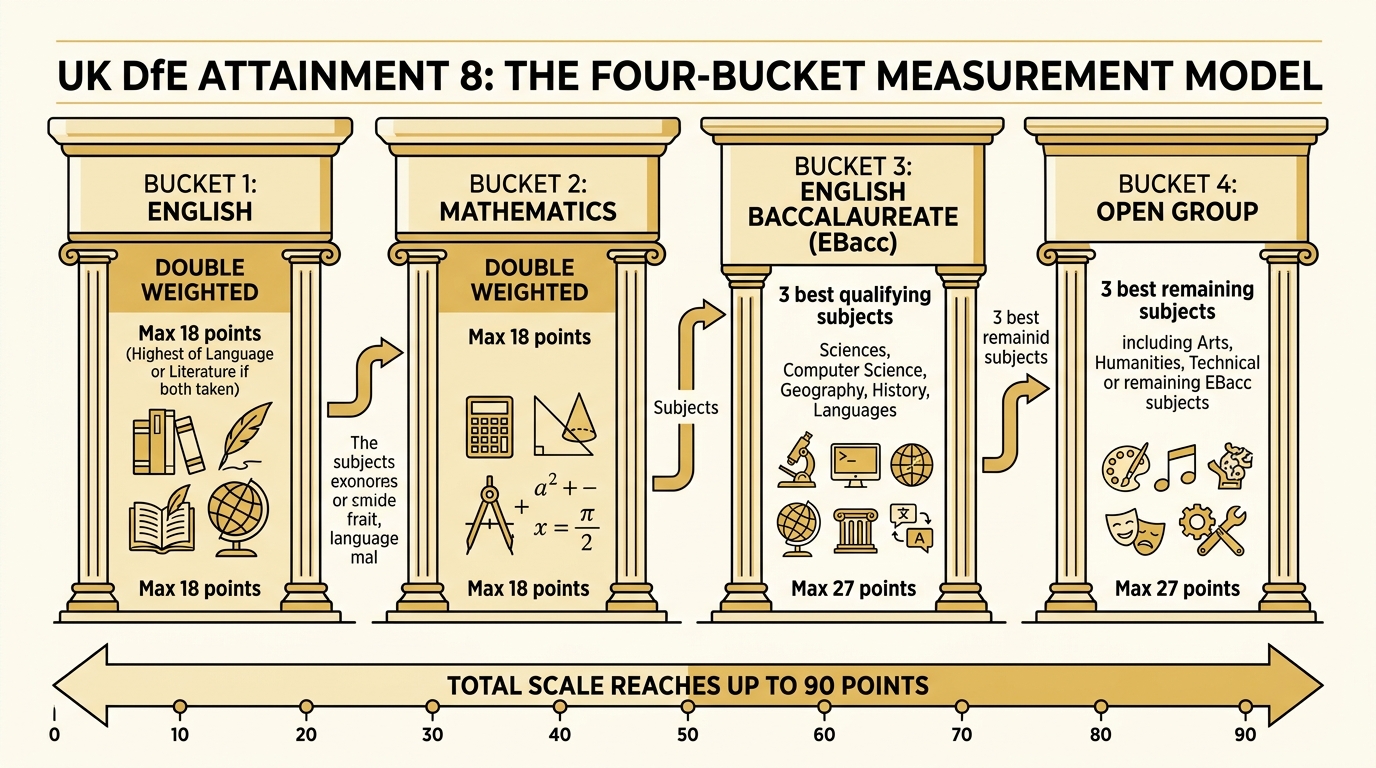
English bucket — double weighted, maximum 18 points
The higher of English Language and English Literature is doubled, provided both subjects were sat. The lower grade moves into the Open bucket if there is space. A candidate with English Language at Grade 8 and English Literature at Grade 7 has a bucketed score of sixteen, with the Grade 7 available for the Open bucket. A candidate who sat only English Language and earned a Grade 8 has a bucketed score of sixteen, with no second English grade to allocate.
Mathematics bucket — double weighted, maximum 18 points
The Mathematics grade is doubled. There is no alternative to this. The bucketed score is simply twice the grade the candidate earned. A candidate with Grade 9 in Mathematics contributes eighteen points to the Attainment 8 total from this bucket alone.
EBacc bucket — three subjects, maximum 27 points
The three highest grades from the EBacc subject list are counted. The EBacc subjects are the sciences (Biology, Chemistry, Physics, Combined Science), computer science, history, geography, and the modern and ancient languages (French, Spanish, German, Italian, Mandarin, Russian, Arabic, Urdu, Latin, and a small number of others). Combined Science is a double award and counts as two separate grades in the bucket. Any EBacc subject that does not fit into the three bucket slots can be allocated to the Open bucket instead.
Open bucket — three subjects, maximum 27 points
Any remaining qualifications that count towards Attainment 8 can fill the three Open bucket slots. This includes the second English grade, any EBacc subject that overflowed from the previous bucket, and qualifications such as Art, Music, Drama, Design and Technology, Business Studies, Economics, Physical Education, and Religious Studies. Vocational Level 2 qualifications approved by the Department for Education also count in the Open bucket.
A worked example
Take a candidate who sat ten GCSE subjects with the following grades. The list below shows the grade and the bucket each subject falls into once the Attainment 8 rules are applied.
| Subject | Grade | Points | Bucket |
|---|---|---|---|
| English Language | 8 | 16 | English (doubled) |
| English Literature | 7 | 7 | Open |
| Mathematics | 9 | 18 | Mathematics (doubled) |
| Biology | 8 | 8 | EBacc |
| Chemistry | 8 | 8 | EBacc |
| Physics | 8 | 8 | EBacc |
| History | 8 | 8 | Open |
| Computer Science | 8 | 8 | Open |
| Spanish | 7 | 0 | Not counted (surplus) |
| Business Studies | 7 | 0 | Not counted (surplus) |
The English contribution is sixteen points, from the doubled Grade 8. The Mathematics contribution is eighteen points, from the doubled Grade 9. The EBacc bucket takes the three highest EBacc grades, which are Biology, Chemistry, and Physics at eight each, so it contributes twenty-four points. The Open bucket takes the three highest remaining grades, which are History at eight, Computer Science at eight, and English Literature at seven, so it contributes twenty-three points. The Attainment 8 total is sixteen plus eighteen plus twenty-four plus twenty-three, which is eighty-one points out of ninety.
Notice that Spanish and Business Studies, both at Grade 7, are not counted. This is not a mistake. Once the eight counted slots are filled with stronger grades, the surplus subjects have no effect on Attainment 8. The average grade across all ten subjects is seven point nine, which is a slightly different figure from the Attainment 8 score because Attainment 8 excludes the two surplus subjects and doubles two of the counted ones. Both figures are useful, and both are reported by the tool.
Sixth Form and college entry thresholds
Post-16 institutions in England set their own entry requirements, and the thresholds differ between grammar school Sixth Forms, general Sixth Form Colleges, and Further Education colleges. The most common pattern is that selective institutions ask for a higher average grade and specific subject grades, general Sixth Forms ask for a moderate average with passes in English and Mathematics, and Further Education colleges accept a wider range and place candidates with lower grades into foundation or Level 2 pathways.
| Institution type | Typical minimum |
|---|---|
| Selective grammar school Sixth Form | Six or more Grade 7s, specific Grade 8s in A-Level subjects |
| High-performing academy Sixth Form | Five Grade 6s, Grade 6 in target A-Level subjects |
| General Sixth Form College | Five Grade 4s including English and Mathematics, Grade 5 or 6 in target subjects |
| Further Education college | Four Grade 4s, foundation Level 2 pathways available |
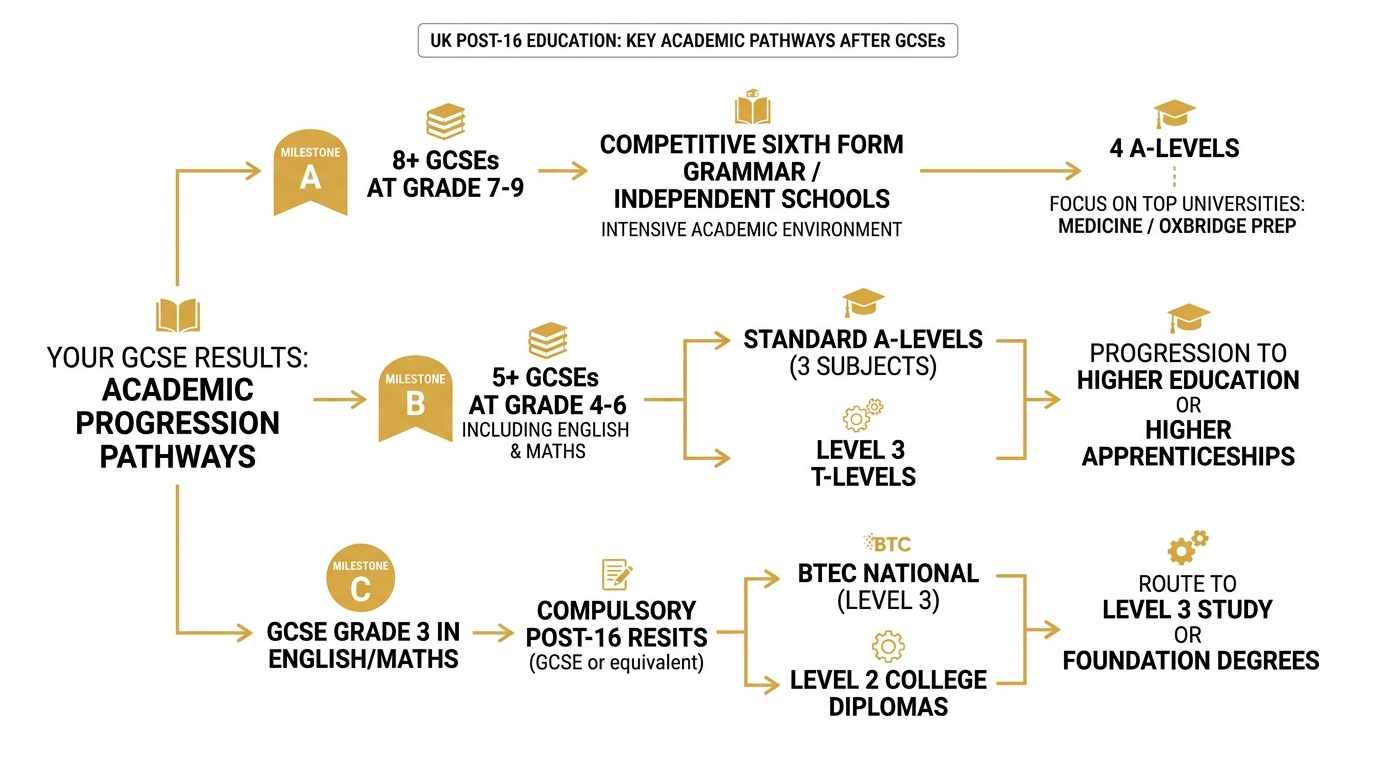
The specific requirements vary between institutions and sometimes between subjects within the same institution. A candidate applying for A-Level Mathematics is usually asked for a higher grade in GCSE Mathematics than a candidate applying for A-Level History, even at the same school. The prospectus for the specific institution and the specific course is the definitive source for the exact requirements, and the tool's eligibility band is a broad reference rather than a guarantee of admission.
Common mistakes when reading GCSE results
A handful of recurring errors make a candidate's own estimate of their standing diverge from what the school reports or what a post-16 institution sees on the application.
Treating the average grade as the Attainment 8 score. The two figures are different. The average grade is the sum of all grades divided by the number of subjects. The Attainment 8 score selects eight specific subjects into four buckets and double-weights two of them. A candidate with an average of seven point five can have an Attainment 8 score between sixty and eighty depending on how the subjects fall into the buckets and how many surplus subjects they sat.
Assuming all EBacc subjects count automatically. Only three EBacc grades enter the EBacc bucket. Any additional EBacc subjects compete for the Open bucket slots against non-EBacc subjects, and only the three highest remaining grades count. A candidate with four strong EBacc subjects may find that the fourth one displaces a weaker non-EBacc subject in the Open bucket, which is fine, but the fourth one does not create a fourth EBacc slot.
Ignoring the double weighting on English and Mathematics. The two double-weighted buckets together account for thirty-six of the ninety possible Attainment 8 points. A candidate who underperforms in English or Mathematics loses twice as much on the score as they would in any other subject. The strategic implication is that improvement in these two subjects has an outsized effect on the final figure.
Confusing standard pass and strong pass. A Grade 4 is a standard pass, a Grade 5 is a strong pass, and some institutions quote one while meaning the other. Reading the specific prospectus carefully is the only way to know which threshold applies to the specific course, and the same institution may use different thresholds for different programmes.
Assuming Combined Science counts as one subject. Combined Science is a double award and counts as two GCSEs in the Attainment 8 buckets. A candidate with Combined Science at 7-6 contributes a seven and a six, not a single averaged grade. The tool handles this correctly when the two numbers are entered as separate rows.
Overlooking the statutory resit requirement. A Grade 3 in English Language or Mathematics triggers a compulsory resit at the post-16 institution. A candidate who plans to study A-Levels without addressing a Grade 3 in either subject will find that the resit is a condition of continued study, and the time spent on the resit reduces the time available for the A-Level subjects themselves.
Where this calculator stops
This tool estimates the average grade, the Attainment 8 score, and the Sixth Form eligibility band from the subjects and grades you enter, applying the standard Department for Education rules and the commonly applied entry thresholds. It does not know the specific requirements of any individual institution, does not know whether the specific qualification you sat is on the current DfE approved list for Attainment 8 purposes, and does not know the specific grade boundaries that the exam boards applied in any particular series. The official results and the school's own Attainment 8 calculation are the definitive documents, and the receiving institution's prospectus is the authoritative source for entry requirements.
Use this calculator to see where your profile stands, to understand which subject or bucket would improve the most if it moved up a grade, and to plan the choices in the subjects that remain. The average grade and Attainment 8 score shown here match the published DfE methodology, and the entry bands reflect the common thresholds that most post-16 institutions apply. Where a specific institution's requirements differ from the broad pattern, the prospectus is the source to consult.
Double award science: The 17-point 9-9 to 1-1 scale
Over two-thirds of GCSE pupils across England sit Combined Science (frequently titled Trilogy or Synergy by AQA, or Combined Science by Edexcel and OCR) rather than the three separate Triple Science disciplines (Biology, Chemistry, and Physics). Combined Science covers the core content of all three scientific disciplines across six examination papers, but culminates in a double GCSE qualification awarded across a unique 17-tier hyphenated grade spectrum:
| Combined Science Grade | Points Attributed (Grade 1) | Points Attributed (Grade 2) | Total Attainment 8 Contribution | Equivalence / Standard |
|---|---|---|---|---|
| 9-9 | 9.0 | 9.0 | 18.0 points | Top A* / A* Double First |
| 9-8 | 9.0 | 8.0 | 17.0 points | Borderline Grade 9 / Grade 8 |
| 8-8 | 8.0 | 8.0 | 16.0 points | Straight Grade 8 / Grade A* standard |
| 8-7 | 8.0 | 7.0 | 15.0 points | High Grade A benchmark |
| 7-7 | 7.0 | 7.0 | 14.0 points | Grade 7 / Grade A benchmark (Standard STEM A-Level threshold) |
| 7-6 | 7.0 | 6.0 | 13.0 points | Strong pass above Grade B |
| 6-6 | 6.0 | 6.0 | 12.0 points | Solid Grade B equivalent (Standard Sixth Form entry floor) |
| 6-5 | 6.0 | 5.0 | 11.0 points | Intermediate B/C boundary |
| 5-5 | 5.0 | 5.0 | 10.0 points | Government Strong Pass benchmark |
| 5-4 | 5.0 | 4.0 | 9.0 points | Solid pass across all papers |
| 4-4 | 4.0 | 4.0 | 8.0 points | Government Standard Pass benchmark (Grade C equivalent) |
| 4-3 | 4.0 | 3.0 | 7.0 points | One standard pass, one sub-pass |
| 3-3 to 1-1 | 3.0 to 1.0 | 3.0 to 1.0 | 6.0 to 2.0 points | Below Level 2 threshold; does not satisfy Level 3 entry |
In the DfE Attainment 8 framework, both halves of a Combined Science award are eligible for the EBacc bucket. For instance, a candidate with Combined Science 7-6 places a 7.0 and a 6.0 into the EBacc group, leaving only one remaining EBacc slot to fill with Geography, History, Computer Science, or a foreign language.
Foundation vs Higher tiering and grade boundary dynamics
In Mathematics, Combined Science, French, Spanish, and German, examination boards require schools to enter candidates for either the Foundation Tier or the Higher Tier. Understanding tier caps is crucial when setting realistic revision targets:
- Foundation Tier: The maximum attainable result is strictly capped at Grade 5 (or Grade 5-5 in Combined Science). If a student achieves 100% on every Foundation examination paper, their recorded award cannot exceed Grade 5. Grades range from 5 down to 1 (with Grade U below Grade 1).
- Higher Tier: Targets grades from Grade 9 down to Grade 4 (with an allowed safety net margin at Grade 3). If a candidate sitting Higher Tier misses the raw mark boundary for Grade 3, they receive an automatic Grade U (Ungraded), receiving zero points.
- The Strategic Tiering Dilemma: A pupil targeting a Grade 5 Strong Pass in GCSE Mathematics has virtually zero safety margin on Foundation Tier (requiring roughly 75% to 80% raw marks), whereas on Higher Tier, a Grade 5 typically requires only 30% to 35% raw marks. However, a Higher Tier candidate risking a Grade 3 or U must be carefully evaluated by teachers before final entry deadlines.
Ofqual Comparable Outcomes Principle: Each summer, the Office of Qualifications and Examinations Regulation (Ofqual) adjusts raw mark grade boundaries so that pupils of similar prior Key Stage 2 attainment achieve comparable proportions of grades from year to year. If an examination paper is exceptionally difficult, the boundary for Grade 9 drops; if a paper is accessible, the boundary rises. When using single-subject component calculators, target raw percentages should always factor in historical 3-year grade boundary variance (+/- 5%).
How schools convert Attainment 8 into Progress 8
While students focus on their personal Attainment 8 total (out of 90 points), the Department for Education evaluates schools using Progress 8. Progress 8 measures how much academic progress a pupil made from the end of primary school (Key Stage 2 SATs) to the end of Year 11 compared to pupils nationally who had similar starting points:
- Calculate Attainment 8: The pupil's eight best qualifying subjects are scored across the four buckets, yielding a figure between 0 and 90.
- Determine National Attainment 8 Estimate: The DfE establishes a benchmark table that assigns an expected Attainment 8 score to every Key Stage 2 prior attainment tier (based on Year 6 Reading and Maths scaled scores). For example, a student with a Key Stage 2 average scaled score of 108 may have an estimated Attainment 8 score of 54.20.
- Compute Pupil Progress 8 Score: Subtract the estimated Attainment 8 score from the pupil's actual Attainment 8 score, then divide by 10. If the student achieved an Attainment 8 score of 62.0, the calculation is: (62.0 - 54.20) / 10 = +0.78.
- Interpretation of Results: A Progress 8 score of +0.78 indicates that the pupil achieved almost four-fifths of a grade higher across all eight subjects than the national average for peers with identical primary school SATs. A score of 0.0 reflects exact national parity, while negative scores indicate pupils made less progress than national peers.
Subject-specific A-Level and T-Level entry matrix
General Sixth Form entry requirements (such as achieving five Grade 4s or 5s) are only the baseline. To enroll in specific advanced Level 3 courses, schools enforce rigorous subject-specific grade gates:
| Intended A-Level / T-Level Course | Minimum GCSE Prerequisite (Typical) | Selective Sixth Form Prerequisite (Grammar/High-Achieving) | Rationale & Curriculum Demand |
|---|---|---|---|
| A-Level Mathematics | Grade 6 in GCSE Mathematics | Grade 7 or 8 in GCSE Mathematics | Steep jump in algebraic manipulation and calculus abstraction. |
| A-Level Further Mathematics | Grade 8 in GCSE Mathematics | Grade 8 or 9 in GCSE Mathematics | High-level pure mathematics, complex numbers, and matrices. |
| A-Level Biology / Chemistry / Physics | Grade 6-6 in Combined Science (or 6 in Triple) + Grade 6 in Maths | Grade 7-7 in Combined Science (or 7 in Triple) + Grade 7 in Maths | Heavy quantitative data analysis, chemical kinetics, and thermodynamics. |
| A-Level English Literature | Grade 5 or 6 in English Literature or Language | Grade 7 in English Literature and Language | Extensive essay composition, unseen textual analysis, and critical theory. |
| A-Level Economics / Psychology / Sociology | Grade 5 in English Language + Grade 5 in Mathematics | Grade 6 in English Language + Grade 6 in Mathematics | Demands both statistical interpretation and structured analytical writing. |
| T-Level Digital / Engineering (Level 3) | Five Grade 4s including English & Maths | Five Grade 5s including English & Maths or Science | Combines 80% classroom theory with a 45-day mandatory industry placement. |
Compulsory post-16 retake rules and funding conditions
Under statutory guidance enforced by the Education and Skills Funding Agency (ESFA), English and Mathematics GCSE passes carry legal consequences for 16-to-19 funding:
- Condition of Funding Rule: Any student who completes Year 11 without achieving at least a Grade 4 in GCSE English (Language or Literature) or GCSE Mathematics must continue studying that subject post-16 as part of their study programme. Further education colleges and school Sixth Forms that fail to enroll eligible students on resit courses forfeit government per-student funding allocations.
- Grade 3 Requirement (GCSE Resit Mandatory): Students who finish Year 11 with an exact Grade 3 in English or Maths are legally required to study toward the full GCSE qualification and re-sit the examination papers (either in the November exam series or the following June). They cannot substitute Functional Skills qualifications.
- Grade 2 and Below (Stepping Stone Qualifications): Students who achieve Grade 2 or Grade 1 (or Grade U) may take Functional Skills Level 2 qualifications as a stepping stone pathway before progressing to GCSE resits.
- Impact on A-Level Study: Retaking GCSE English or Mathematics requires 3 to 4 hours of weekly timetabled classes alongside your main subjects. For students attempting three demanding A-Levels, the simultaneous burden of preparing for a November or June GCSE resit significantly increases workload, which is why securing a clean Grade 4 or 5 in Year 11 is critical.
Sources
- Ofqual. GCSE 9 to 1 Grading Standards and Regulatory Framework. gov.uk/government/organisations/ofqual
- Department for Education. Progress 8 and Attainment 8 School Performance Measures. gov.uk/government/publications/progress-8-school-performance-measure
- AQA. GCSE Specifications and Assessment Materials. aqa.org.uk
- Pearson Edexcel. GCSE Qualifications. qualifications.pearson.com
- Cambridge Assessment International Education. Cambridge IGCSE. cambridgeinternational.org